

This page provides various information about the cooling of the breathing gas in rebreathers
Cooling Breathing Gas in Closed Breathing Systems: An Overview of Methods
In closed breathing systems, such as rebreathers for deep-sea diving or breathing apparatus for firefighting and rescue operations, the breathing gas heats up significantly. This has two root causes: the user’s body heat and the chemical reaction in the CO2 scrubber (the soda lime canister). Purifying breathing gas using soda lime CaOH2 is a highly exothermic (heat-producing) reaction.
To prevent the user from inhaling dangerously hot and humid gas, cooling is necessary. In doing so, a critical balance must be maintained: the CO2 absorption granules require heat and moisture to perform chemically effectively. If the gas cools down too much before or inside the scrubber, the operation stops and there is a risk of CO2 poisoning (hypercapnia). Cooling systems are therefore almost always placed after the scrubber (in the inhalation hose or the inhalation counterlung).
Below, the five known methods for cooling breathing gas are described step by step.
1. Phase Change Materials (PCM) and Chemical Cooling
This method utilizes the latent heat (heat of fusion) of specific substances to actively extract heat from the breathing gas without the cooler itself rising in temperature.
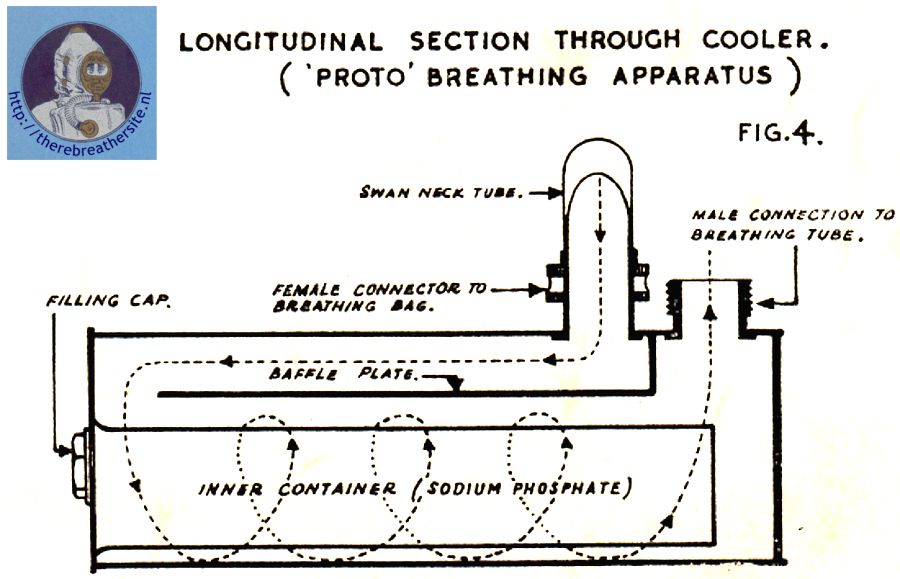
Calcium chloride hexahydrate CaCl2.6 H2O: This salt hydrate was historically applied in early breathing apparatus and rebreathers, such as the well-known Siebe Gorman Proto. It has a melting point of approximately 29°C to 30°C (86°F). As soon as the breathing gas becomes warmer than this temperature, the solid salt begins to melt according to the physical phase transition:
CaCl2.6 H2O (s) + ΔH -> CaCl2.6H2O (l)
- During this melting process, the temperature remains constant at around 29°C, effectively cooling the breathing gas to a comfortable inhalation temperature.
- Important safety aspect (Dissolving vs. Melting): Only an already fully hydrated form (the hexahydrate) in a hermetically sealed enclosure may be used. If anhydrous calcium chloride CaCl2 comes into contact with water or moisture, exactly the opposite happens: a highly exothermic reaction occurs that generates extreme heat.
- Cooler construction: In historical systems, this PCM was contained within a flat, oval copper container (the Cooler). An internal baffle plate ensured that the gas was optimally guided along the cooling reservoir. After use, cold water had to be circulated around the container to revert the salt to its crystallized form. The exterior should never be polished, as a glossy surface attracts external heat and reduces efficiency.
- Modern alternatives: Later, sodium phosphate was also applied as a cooling agent, which begins to liquefy at approximately 36°C (97°F).
2. Active Cooling by Ice or Ice Cartridges (Thermal Mass)
This is the most effective method for systems with a long breathing duration in extremely warm environments, such as mine rescue work or diving in tropical waters.
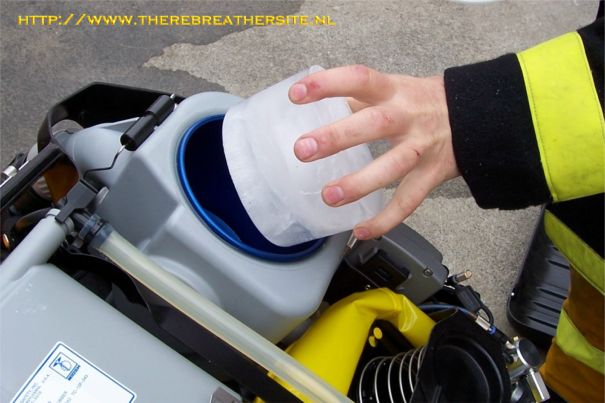
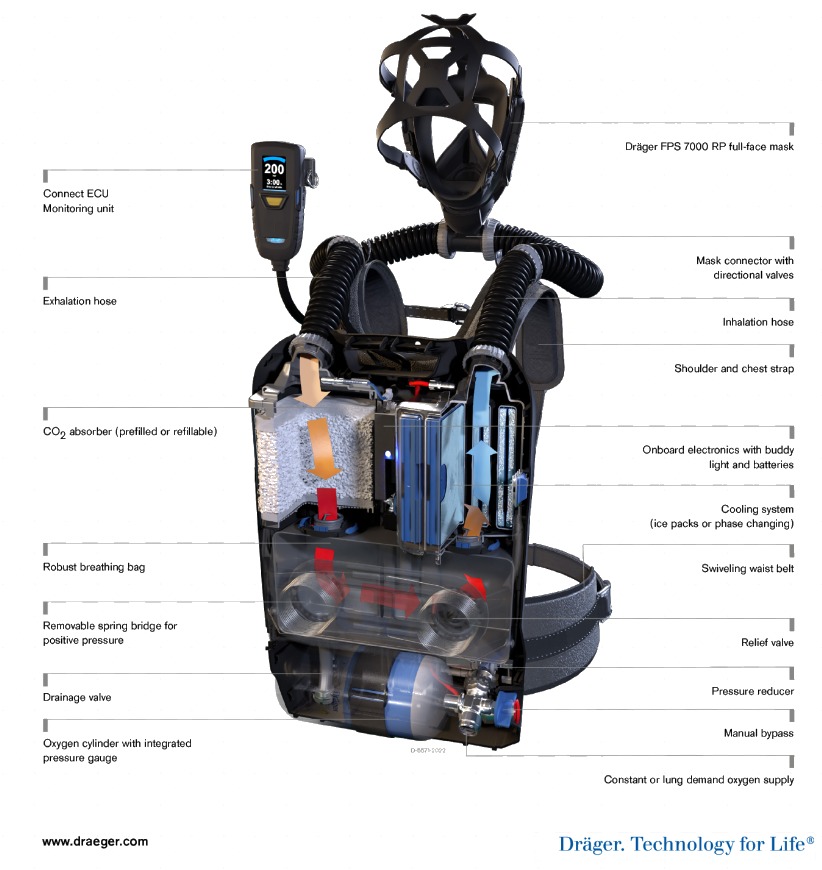
- Ice chambers and ice cartridges: Industrial breathing systems (such as the Dräger BG4) feature a special compartment where a frozen cartridge or loose ice is placed.
- Operation: The warm breathing gas flows directly past this ice reservoir. The heat is directly absorbed by the melting energy of the ice.
3. Passive Ambient Cooling via the Counterlungs
In diving systems (rebreathers), grateful use is made of the lower temperature of the surrounding water.
- Conduction via counterlungs: The flexible breathing bags in which the gas expands and is temporarily stored are often made of materials with good thermal conductivity.
- Operation: If the surrounding outside water is colder than the breathing gas, the counterlung acts directly as a passive heat exchanger.
4. Mechanical Heat Exchangers
This method relies on mechanical constructions to dissipate heat to the immediate environment.
- Metal gas lines and fins: After the scrubber, the warm gas is guided through metal (often copper or aluminium) tubes equipped with cooling fins.
- Application: In diving equipment, these fins are in direct contact with the cold outside water. In land-based systems (such as for firefighting), they are in contact with the ambient air.
5. Passive Expansion Cooling by Cold Source Gas
This effect occurs naturally when fresh breathing gas is added to the system.
- Joule-Thomson effect: When fresh gas (oxygen or a diluent such as trimix) is injected from the high-pressure cylinder (200 to 300 bar) via demand valves into the low-pressure breathing loop, the gas expands rapidly.
- Operation: Due to this rapid expansion, the injected gas cools down significantly. Although this effect is secondary during continuous breathing, the injection of this cold gas does help to slightly lower the overall temperature in the breathing loop.

Therebreathersite was founded by Jan Willem Bech in 1999. After a diving career of many years, he decided to start technical diving in 1999. He immediately noticed that at that time there was almost no website that contained the history of closed breathing systems. The start for the website led to a huge collection that offered about 1,300 pages of information until 2019. In 2019, a fresh start was made with the website now freely available online for everyone. Therebreathersite is a source of information for divers, researchers, technicians and students. I hope you enjoy browsing the content!