

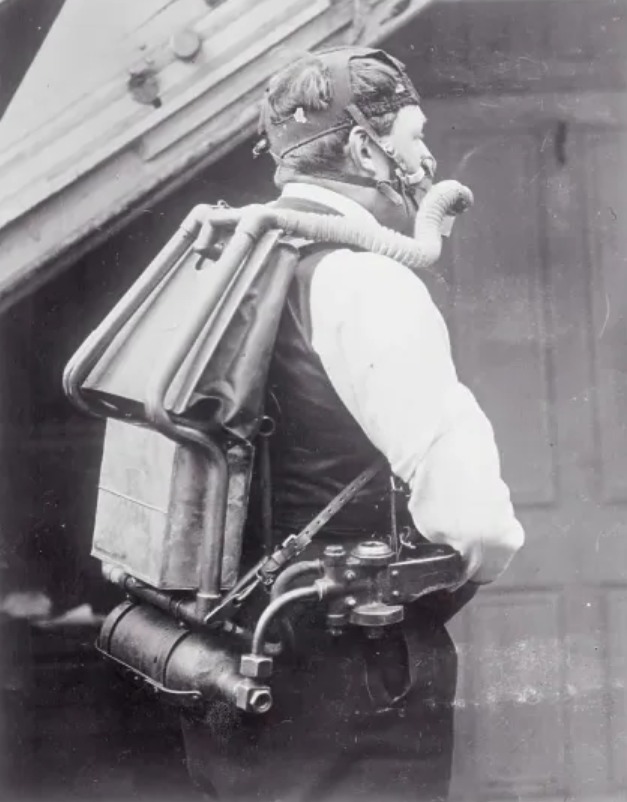
One of the early minerescue oxygen rebreathers designed in 1906
Information on the Meco-Briggs Breathing Apparatus
factual information regarding the Meco-Briggs breathing apparatus:
- Manufacturer: The Meco apparatus was produced by the Mining Engineering Company (MECO), based in Sheffield, and later the Briggs apparatus was manufactured by Meco and also Siebe, Gorman.
- Design and Principle: Introduced in 1906, the original Meco was almost identical in principle to the German “Shamrock” apparatus. It was a compressed oxygen system that introduced a constant rate of oxygen into the circuit, @ 2.3 ltr/min
- Performance and Evaluation:
- In a 1911 competition by the Society of Arts, the Meco was awarded a silver medal.
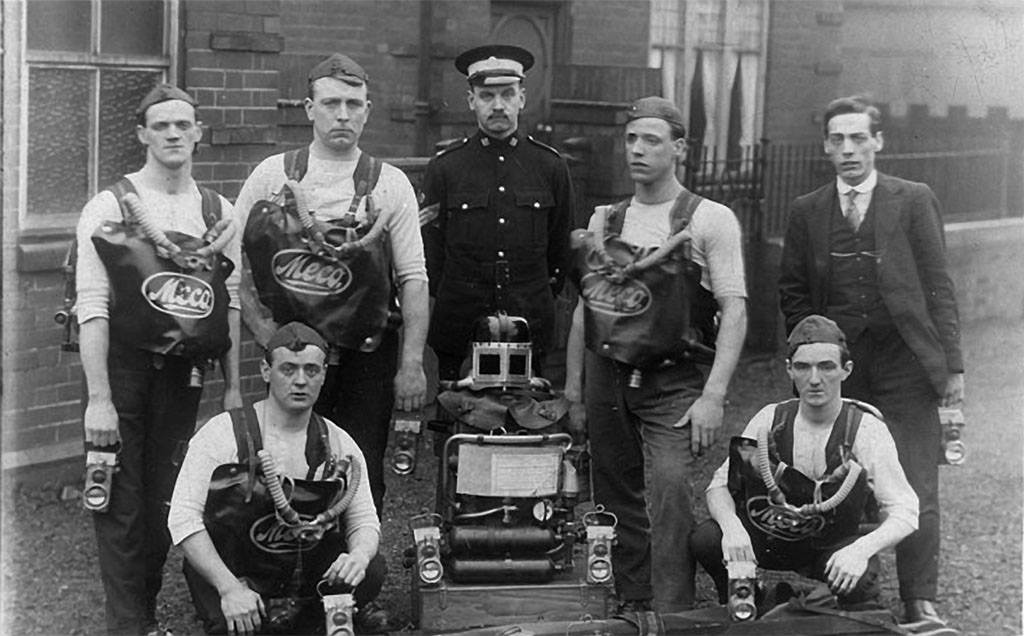
- By 1916, there were 455 Meco sets in use in Britain, making it the second most common type after the Proto.
- A 1914 report by John Scott Haldane noted a serious defect: leaks could occur through the helmets of both the Draeger and the Meco apparatus.
- Evolution:
- Henry Briggs, a professor, developed a new design of compressed oxygen apparatus with an improved purifier.
- This new design, known as the Briggs apparatus (or the Briggs-Meco/Briggs-Siebe), was manufactured by Meco, but it failed to surpass the market dominance of the Proto apparatus.
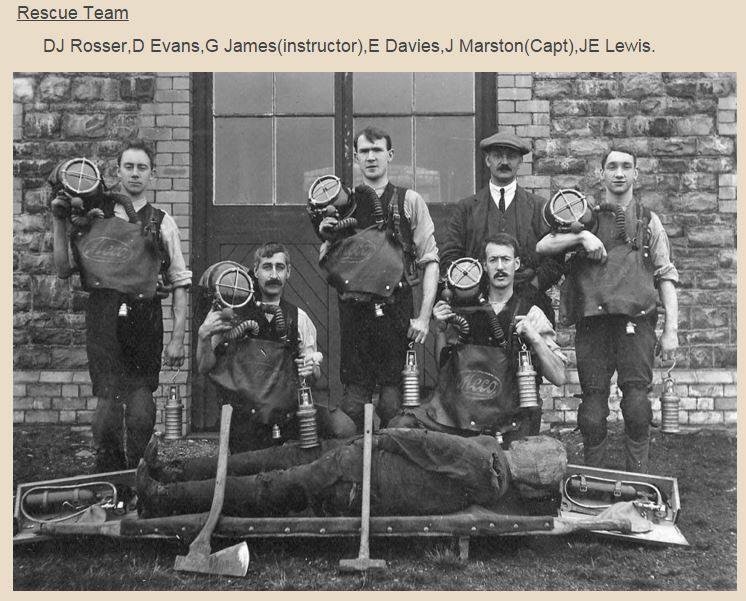
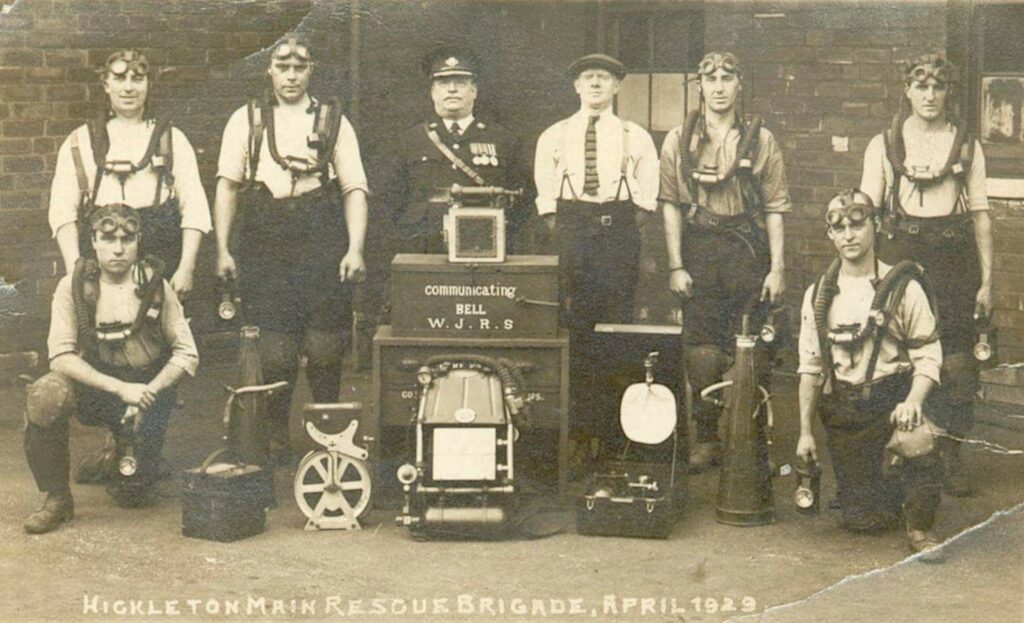
- Use: The Meco was one of several competing breathing apparatus types used in British mine rescue stations in the early 20th century, alongside the Proto, Draeger, Weg, and Aerophor models. Some stations, like Rotherham, initially purchased Meco sets for use as a backup to their main Aerophor system.

A Landmark Study of Mine Rescue Technology: “Baking a New Technology”
John Singleton’s paper, “Baking a New Technology: Breathing Apparatus for Mine Rescue in Britain, c. 1890 – c. 1930,” offers a vital and thoroughly researched look into the complex development of life-saving equipment during a critical period in industrial history. The author masterfully uses the metaphor of “baking a new technology” to frame how various “ingredients”—including commercial enterprises, individual inventors, academic scientists, and rescue station staff—collaborated and competed to improve breathing apparatus for dangerous mine environments.
This paper is highly valuable for several reasons:
- Comprehensive Historical Context: The research meticulously details the social and regulatory pressures that led to the compulsory use of breathing apparatus in Britain after the Mines Accidents Act of 1910 and the Coal Mines Act of 1911 (pp. 2, 8). It explains the grim reality of mine explosions and the urgent need for reliable rescue technology (pp. 2, 5).
- Insightful Analysis of Innovation: Singleton effectively applies theories of collective, open-source, and user innovation to the historical evidence, providing a sophisticated framework for understanding technological progress (p. 3). He highlights the crucial role played by the Institution of Mining Engineers (IME) and its Transactions journal as a forum for intense debate and knowledge sharing among practitioners, which ultimately spurred manufacturers to improve their designs (pp. 2, 9, 18).
- Focus on Practical Challenges: The paper does not shy away from the practical limitations and dangers of early apparatus, including issues with overheating, leakage, and the need for rigorous training (pp. 12, 20). This grounded approach adds realism to the narrative of innovation.
- Detailed Case Studies: By focusing on specific rescue stations, such as Rotherham, the paper illustrates how local ‘tinkering’ and user modification significantly refined commercially available products like the Aerophor (pp. 3, 22).
Ultimately, Singleton presents a compelling argument that the development of effective mine rescue technology was not a straightforward commercial process but a messy, collaborative, and often argumentative collective effort driven by humanitarian aims and a desire for safer working conditions (pp. 6, 24).
I would like to take this opportunity to express my sincere gratitude to John Singleton, Professor of Economic and Business History, Department of Humanities (Owen 1155), Sheffield Hallam University, for his much appreciated permission to publish this paper for the readers of my website. John, much appreciated!

Therebreathersite was founded by Jan Willem Bech in 1999. After a diving career of many years, he decided to start technical diving in 1999. He immediately noticed that at that time there was almost no website that contained the history of closed breathing systems. The start for the website led to a huge collection that offered about 1,300 pages of information until 2019. In 2019, a fresh start was made with the website now freely available online for everyone. Therebreathersite is a source of information for divers, researchers, technicians and students. I hope you enjoy browsing the content!
Leave a Reply