by Jan Willem Bech | Database OX UK
gb Sir Robert Davis 1870 – 1965 Sir Robert Davis and Siebe Gorman The history of the firm Siebe Gorman forms the backbone of modern diving and respiratory technology and actually begins with the arrival of Augustus Siebe in London in the early nineteenth...
by Jan Willem Bech | Database OX UK
gb Proton rebreather (experimental?) The Siebe Gorman Proton breathing apparatus has the characteristics of a semi-closed system that works with oxygen and a diluent gas or with nitrox. The device would then belong in the semi-closed database. However, there is...
by Jan Willem Bech | Database OX UK
gb Selected Elevated Flow Apparatus Sabre SEFA Sabre developed their SEFA (Selected Elevated Flow Apparatus) in conjunction with Mines Rescue Service. It was UK approved by the HSE in 1985. The apparatus was a positive pressure closed circuit breathing system with...
by Jan Willem Bech | Database OX UK
gb OXYLET SMALL EMERGENCY APPARATUS(R. H. DAVIS’S Patent) Figure 1 shows a small, self-contained breathing apparatus for short emergency use in poison gas or underwater. This apparatus includes a watertight breathing bag with a “Protosorb” CO₂...
by Jan Willem Bech | Database OX UK
gb Oxilithe used in rebreathers and escape apparatus Oxilithe technology The origin of the Oxilithe technology began with the scientific work of the French chemist Professor Georges Jaubert, who at the beginning of the 20th century discovered that...
by Jan Willem Bech | Database OX UK
gb M.R.S by Siebe Gorman The MRS was an adaptation by Siebe Gorman of an oxygen-nitrogen gas mixture self contained diving dress designed by Sir Robert Davis and his son R.W.G. Davis before World War II. This apparatus was similar in appearance to the standard...
by Jan Willem Bech | Database OX UK
gb One of the early minerescue oxygen rebreathers designed in 1906 Information on the Meco-Briggs Breathing Apparatus factual information regarding the Meco-Briggs breathing apparatus: Manufacturer: The Meco apparatus was produced by the Mining Engineering...
by Jan Willem Bech | Database OX UK
gb Savox mine rescue apparatus Technische data: Pendulum breathing Stalen cilinder 140 liter 5 cu.ft (1,41 ltr) = 100 bar Duration 45 min Used for work in gas in mines U-shaped breathing bag Hutt-off valve with locking mechanism Refillable CO2 Absorbent (Protosorb)...
by Jan Willem Bech | Database OX UK
gb Minox Oxygen Breathing Apparatus Specifications The Minox is a one-hour minimum duration, closed-circuit oxygen breathing apparatus developed by Siebe Gorman (p. 5). Its key innovation is a compact, efficient flow control unit that replaces the conventional...
by Jan Willem Bech | Database OX UK
gb Novus Oxygen Breathing Apparatus The Novus rebreather from Siebe Gorman was primarily developed for the Siebe Gorman submersible decompression chamber. In this chamber, the diver can decompress at various depths by turning a valve on the device to first vent the...
by Jan Willem Bech | Database OX UK
gb The first selfcontained underwater breathing apparatus? In 1825, British inventor William H. James constructed what is widely recognized as the first workable, full-time self-contained underwater breathing apparatus (SCUBA). His new design represented a significant...
by Jan Willem Bech | Database OX UK
The Shadow Enforcer is a new designed oxygenrebreather designed by Divex...
by Jan Willem Bech | Database OX UK
The Miniox self-contained breathing apparatus is specifically engineered for operations in IDLH (Immediately Dangerous to Life or Health) or otherwise irrespirable atmospheres, providing a service life of up to 40 minutes. The system architecture consists of a...
by Jan Willem Bech | Database OX UK
gb Submarine escape breathing apparatus This relatively unknown oxygen rebreather is in the collection of teh Royal Navy Submarine Museum. The device can be seen here thanks to Åke who provided these photos. The device was used aboard HMS Umpire by PO A. Bland who...
by Jan Willem Bech | Database OX UK
gb A special variant of the Salvus The photos below show two unusual configurations of the Salvus oxygen rebreather. No1. Special ‘Salvus’ with oxygen cylinder, reducing valve, carried at the side in a pocket attached to the waist-belt; CO2 absorbent chamber and...
by Jan Willem Bech | Database OX UK
gb Very early 1914 oxygen multi-role rebreather The Salvus ANS The Salvus oxygen rebreather is a multi-purpose device. It was used for firefighting, breathing in toxic atmospheres and for shallow diving up to 33 ft. The device also had application as an Amphibian...
by Jan Willem Bech | Database OX UK
gb Early 1942 the Sladen Suit development The Sladen Suit is named after an English officer named Geoffrey Mainwaring Sladen. Sladen was born in Reigate, Surrey, England, on 3 Aug 1904 baptized and on 31 Aug 1904 married Anna Maria Rolt in Amersham in 1931.Sladen...
by Jan Willem Bech | Database OX UK
gb After 1878, Henry Fleuss and Robert Davis Henry Albert Fleuss and Robert H. Davis In the period between 1878 and 1933, Henry Albert Fleuss and Robert H. Davis worked together at Siebe Gorman & Co. Development began with the well-known Fleuss device, which...
by Jan Willem Bech | Database OX UK
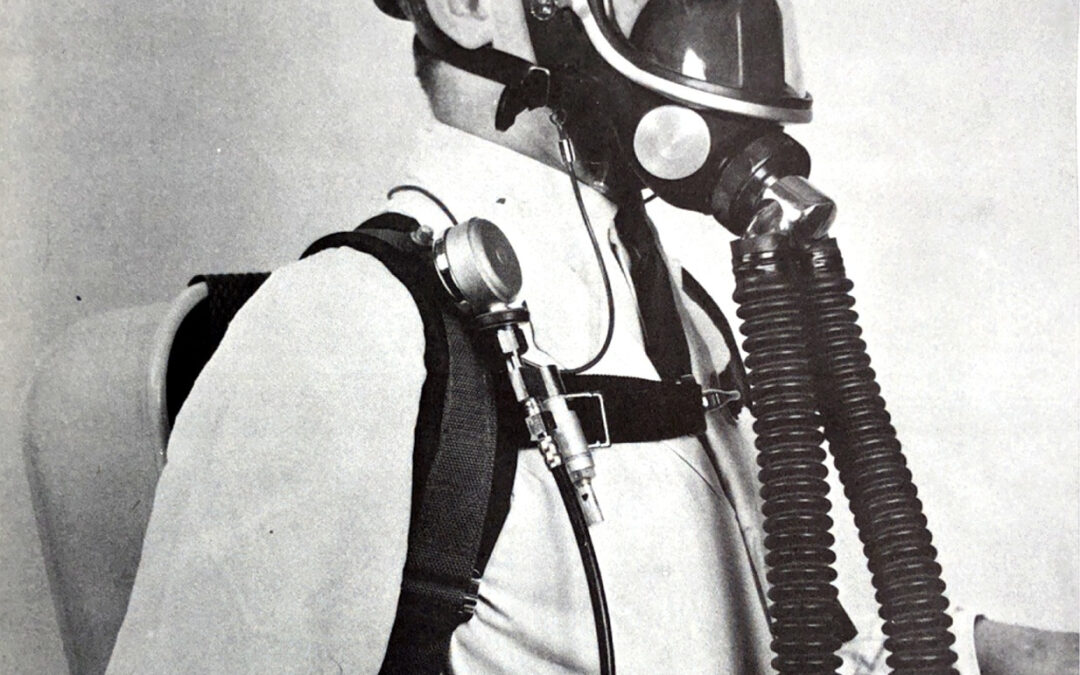
gb Siebe Gorman Stelox oxygen rebreather Aircrew (?) Oxygen rebreather Very little information remains about this breathing apparatus produced in the late 1960s. The device appears to have been used for aviation. The apparatus is an oxygen system with a scrubber and a...
by Jan Willem Bech | Database OX UK
gb Siebe Gorman Vitox oxygen rebreather Constant feed Oxygen rebreather This apparatus is on the same regenerative principle as that of the “Proto”, but instead of being disposed equally back and front of the wearer, it is designed to be carried wholly on the back,...
by Jan Willem Bech | Database OX UK
gb Submarine escape 1906 Captain Hall, Doctor Rees and Robert Davis submarine escape system 1906 using oxylithe Early submarines had a tendency to sink, and a number of accidents before the First World War made the Admiralty look into the possibility of developing an...
by Jan Willem Bech | Database OX UK
gb Amphibian MK2 with neck pattern breathing bag This apparatus is on the same principle as the Amphibian Mark 1, the main difference being in the breathing bag which is formed to fit round the neck and shoulders, as in the “Salvus” A.N.S., instead of on...
by Jan Willem Bech | Database OX UK
gb The original Amphibian MK1 for underwater use and in poison gas Figures 1 and 2, the original “Amphibian” dual-purpose apparatus, i.e., for use in poison gas or under water, consists of a steel cylinder, charged with pure oxygen for depths not exceeding...
by Jan Willem Bech | Database OX UK
gb First practicable Oxygen breathing apparatus 1878 Henry Albert Fleuss, born in 1851 and passing away in 1933, was an esteemed figure in the field of diving engineering, notably serving as the Master Diver for Siebe, Gorman & Co. of London. In the early hours of...